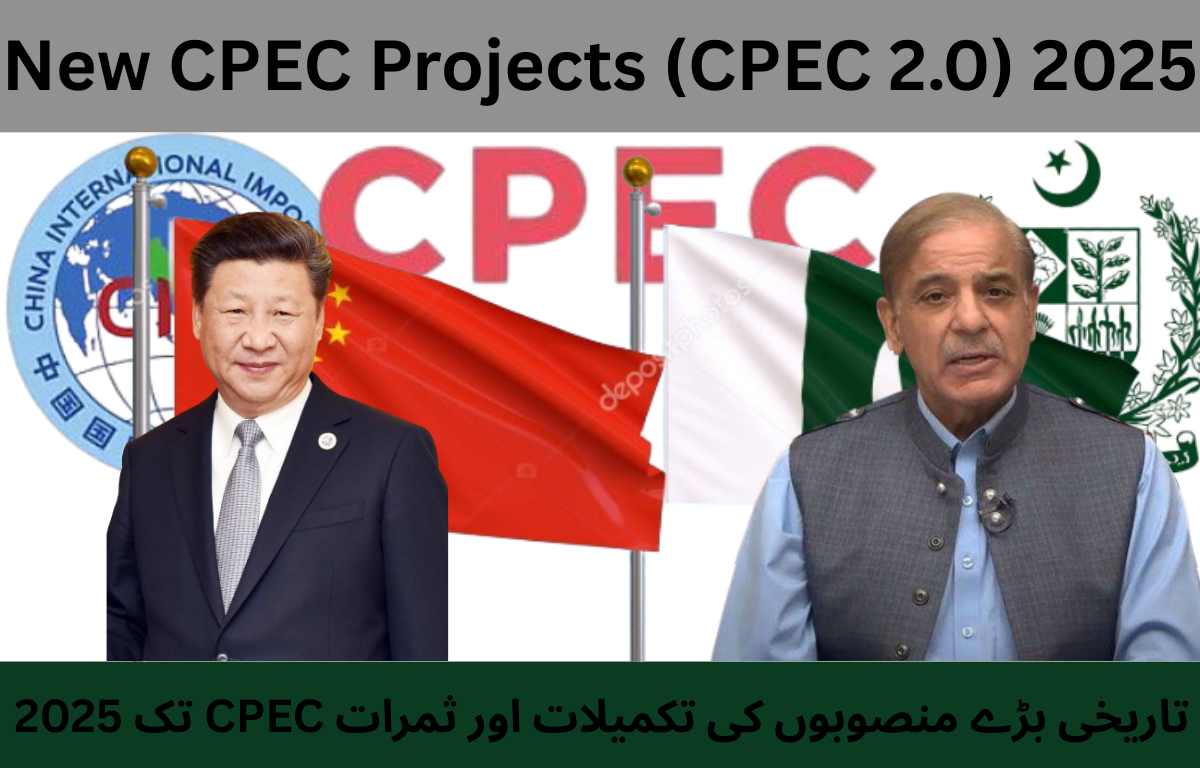
New CPEC Projects (CPEC 2.0) 2025, China Pakistan Economic Corridor (CPEC) is one of the largest projects. The first project, which started in 2015, cost $42 billion. The second phase (CPEC 1.0) was completed from 2015 to 2020 and cost $62 billion.Its main objective is to boost Pakistan’s energy sector. The projects of this program include road connectivity. With the decisions taken in the CPEC 2.0 project, China has entered a new era in Pakistan. This second phase is not only about highways and power plants, but also about industrial development, resource innovation and digital transformation.
ALso Read New CPEC Projects (CPEC 2.0) 2025
Table of Contents
Key New Projects Under New CPEC Projects (CPEC 2.0) 2025

Development of Special Economic Zones (SEZs)
SEZs are the centerpiece of New CPEC Projects (CPEC 2.0) 2025. These zones are designed to attract foreign direct investment (FDI), encourage local manufacturing and create employment.
The priority SEZs include:
🏭 Rishkai SEZ (Khyber Pakhtunkhwa): Focus will be on light engineering, forge processing and IT.
🧵 Allama Iqbal Industrial City (Faisalabad, Punjab): Focus will be on textiles and other goods.
⚙️ Dhabiji SEZ (Sindh): Plans will be made for heavy industries, including increasing production of steel and chemicals.
⛏️ Bostan SEZ (Balochistan): Focus will be on mining and forge processing.
Transition from CPEC 1.0 to CPEC 2.0
CPEC 1.0 initially attempted to address many of Pakistan’s problems:
⚡ Energy shortage: More than 10,000 megawatts of electricity has been generated through coal, hydro, solar and wind projects.
🚛 Road and port connectivity: Gwadar Port has been modernized and major highways such as the M-5 (Multan-Sukkur Motorway) and the Karakoram Highway have been upgraded.
🏗️ Basic infrastructure: The project has been further developed with the support of early investors.
New CPEC Projects (CPEC 2.0) 2025, which was originally launched in 2019, has now undergone many changes and been expanded:
🌾 Agriculture & Food Security: The program will play its role in developing agriculture and securing food.
🔬 Science & Technology: Science and technology will also be worked on.
🚆 Modern Transportation: Modern means of transportation will also be worked on.
🎓 Education, Health & Poverty Alleviation: Education, health and poverty alleviation are the main objectives of this program.
🛣️ Trade Routes: Trade routes will be paved so that Pakistan and China can work together.
Gwadar Smart Port City
Gwadar should be made the center of CPEC. In New CPEC Projects (CPEC 2.0) 2025, Gwadar should be transformed into a smart project with modern infrastructure. The objectives of which will be:
✈️ International Airport: Gwadar should be made an international airport in which its capacity will be increased.
🛣️ Bay Expressway: Gwadar port should be connected to national highways by making it a Bay Expressway.
🏭 Tax-Free Zone: Gwadar should be offered a tax-free phase for free zone investors.
💧 Utilities for Residents: A desalination plant, a power project and water should be provided for the residents.
ML-1 Railway Project
New CPEC Projects (CPEC 2.0) 2025 one of the biggest projects in the pipeline is the Main Line ML-1 Railway Project, which includes:
🚆 Railway Line Upgrade: Upgrading the Karachi-Peshawar railway line, which is 1872 km long.
🏗️ Modernization: Doubling the track, modernizing the stations, and introducing electric trains to Pakistan.
⚡ High-Speed Trains: Raising the speed of trains from 110 to 160 km/h (from 65 to 110 km/h).
Social Sector Development
New CPEC Projects (CPEC 2.0) 2025 aims to provide relief to the people of Pakistan, which is designed to:
🏫 China will establish schools, hospitals, and vocational training centers.
👩👩👧 The program will aim to eradicate poverty, empower women, and provide education.
🏥 Health projects such as the Pakistan-China Friendship Hospital aim to provide affordable care.
Agricultural Modernization
In the CPEC 2.0 project, agriculture has been declared as the backbone of Pakistan’s economy and China is a technological country, so they will work together on agriculture:
🌾 High-Yielding Seeds: By developing high-yielding seeds.
💧 Irrigation Systems: By improving modern irrigation and water systems.
🥶 Cold Storage: By providing cold storage and processing facilities.
🎓 Farmer Training: Pakistani farmers will be organized in Chinese universities.
Digital Silk Road (DSR)
Under CPEC 2.0, work is being done on IT technology in Pakistan and China:
📡 A fiber optic cable is being planned from Khunjerab to Gwadar.
🏢 IT parks and technology zones are being established.
🛒 E-commerce platforms have been introduced to promote small businesses.
🤖 5G technology and artificial intelligence technology and cloud computing systems have been created.
Challenges For New CPEC Projects (CPEC 2.0) 2025

Despite its success, the program is facing many challenges, including:
🛡️ Security concerns in Balochistan.
📑 Delays in approvals and land allocations.
⚖️ Political instability is affecting policy continuity.
💰 Concerns about debt for infrastructure are growing.
🌍 Social pressures from competing global powers will have to be addressed.
Energy Transformation
While CPEC 1.0 required coal and athermal power to eliminate blackouts, CPEC 2.0 has achieved modern energy and has created new projects:
🧪 Hydrogen Power: Hydrogen power stations should be established in Gilgit-Baltistan and Khyber Pakhtunkhwa.
🌞 Solar & Wind Energy: Solar and wind energy farms should be established in Sindh and Punjab.
🔬 Green Hydrogen Research: Research on green hydrogen should be done with the help of China.
Tourism and Cultural Exchange
Both countries are opening their doors to promote tourism to enhance better connectivity:
🏔️ The northern regions will be developed for Chinese and international tourists.
🚌 Joint projects are being developed for hospitality, transport, and ecotourism.
🤝 People-to-people ties are being established through cultural exchange and the media.
Opportunities for New CPEC Projects (CPEC 2.0) 2025

CPEC is creating numerous business opportunities in Pakistan:
💼 Job Creation: Millions of jobs are being created in industries, IT, and agriculture.
📦 Export Growth: Manufacturing is increasing in SEZs.
🤝 Technology Transfer: Skills and knowledge are increasing with the help of China.
🌐 Regional Connectivity: Pakistan will become a gateway to Central Asia.
📊 Economic Stability: There will be less dependence on loans and exports for a diversified sector.
Also Read National Electric Vehicle Policy of Pakistan 2025Future Outlook for New CPEC Projects (CPEC 2.0) 2025
Due to this, a long-term social contract will be established between Pakistan and China. This will have a positive impact on both countries. The following impacts will be achieved in Pakistan:
📍 Pakistan will be made a trade hub.
🏭 Industrial and digital development will increase.
⚡ Energy production will increase through modern renewable sources.
🌾 Agriculture and food security will be helped.
👨👩👧👦 The lives of millions of Pakistanis will be improved.
Conclusion
New CPEC Projects (CPEC 2.0) 2025 is not just about the basic infrastructure but also about improving the system of Pakistan’s economy. This program will improve the economy in both countries. The transaction system in both countries will be improved. It promises modern energy, agriculture, sustainable development and social progress in Pakistan. This program will create an atmosphere of peace and tranquility in both countries.
What is CPEC 2.0?
CPEC 2.0 refers to the second phase of the China-Pakistan Economic Corridor. While the first phase (CPEC 1.0) focused on energy projects and road connectivity, CPEC 2.0 emphasizes industrial cooperation, agricultural modernization, digital transformation, renewable energy, and social development.
When did CPEC 2.0 officially start?
CPEC 2.0 was officially launched in 2019, following the successful completion of early harvest projects under CPEC 1.0. It was agreed upon during the visits of Prime Minister Imran Khan to China and reinforced under subsequent governments.
What are the priority projects under CPEC 2.0?
Some of the major new projects include:
Special Economic Zones (SEZs) such as Rashakai, Dhabeji, Allama Iqbal Industrial City, and Bostan.
ML-1 Railway Upgradation Project from Karachi to Peshawar.
Gwadar International Airport and Free Zone Expansion.
Renewable energy projects (solar, wind, and hydropower).
Agricultural modernization programs with Chinese expertise.
Digital Silk Road initiatives such as IT parks and fiber-optic connectivity.
How will CPEC 2.0 benefit Pakistan’s economy?
CPEC 2.0 will:
Create millions of jobs through industries and SEZs.
Reduce reliance on imports by boosting local manufacturing.
Enhance exports and improve Pakistan’s trade balance.
Strengthen energy security through renewable power.
Improve the social sector, including education, healthcare, and poverty alleviation.
What role does Gwadar play in CPEC 2.0?
Gwadar is the crown jewel of CPEC. In phase two, Gwadar is being developed as a smart port city with modern infrastructure, a free trade zone, international airport, desalination plants, and logistics hubs. It will serve as a gateway to the Middle East, Africa, and Central Asia, making Pakistan a regional trade hub.